
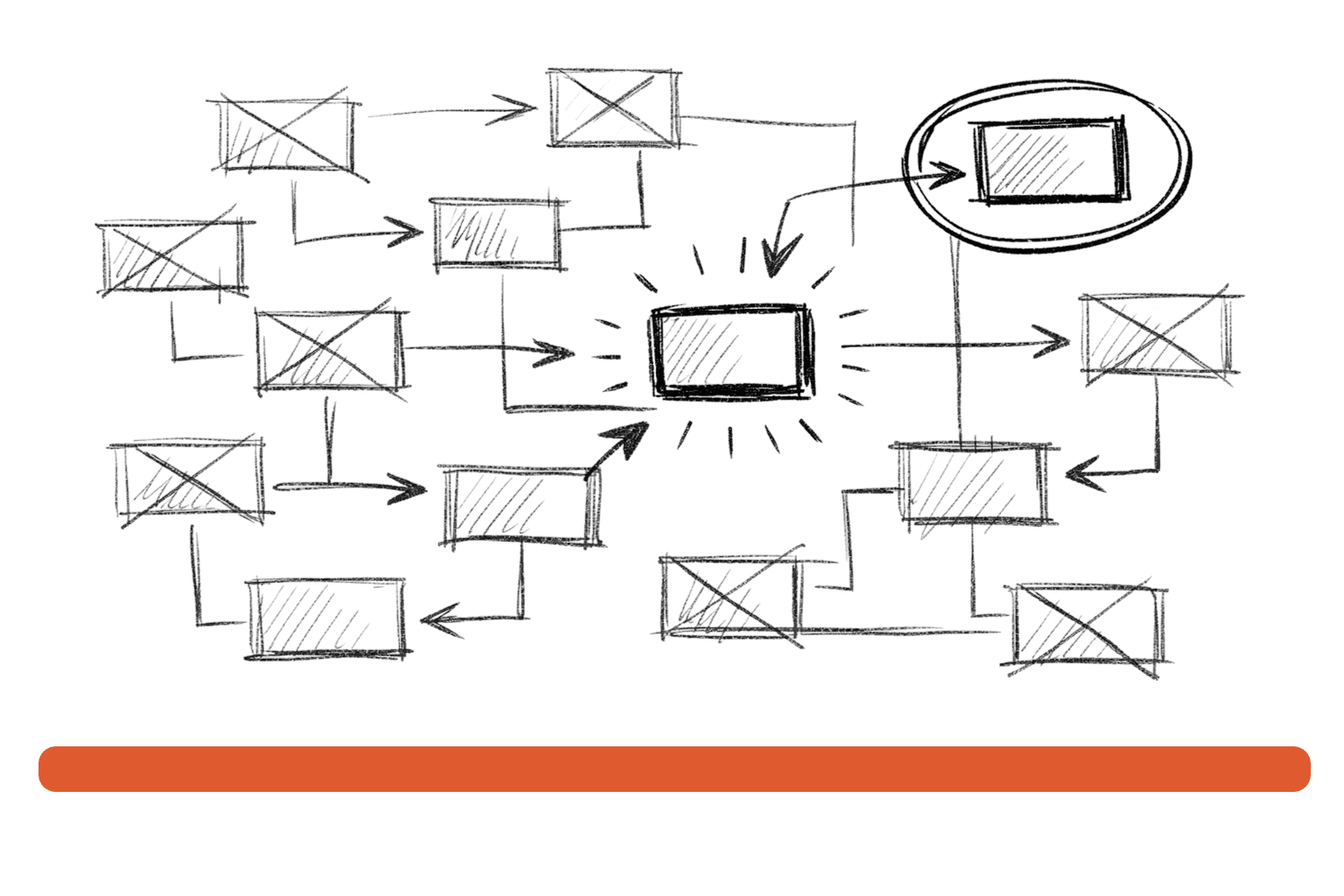
The best AI opportunities are hiding in plain sight: the manual workflows your team does every day that eat up hours of skilled people's time.
Finding where AI can help your business starts with observation. Watch how you work. Ask your team what they spend their time on. Look for the repetitive, time-consuming tasks that show up in every standup or weekly report.
These internal improvements—automating your own workflows—are where AI delivers the clearest ROI. Not because the technology is magic, but because you already know the problem intimately.
Start with a simple question: "What takes my team the most time every week?" The answer usually points directly to your highest-impact AI opportunity.
The numbers back this up. According to an MIT study, 95% of enterprise generative AI pilots failed to deliver measurable impact—usually because they started with technology instead of workflows.
of enterprise AI pilots fail when starting with technology, not workflows
lost per employee to fragmented tools and manual data shuffling
Start With How Work Actually Happens
Before looking at any AI tools, spend time understanding your current workflows. Sit with team members. Shadow a process end-to-end. Ask: what are you doing manually that feels like it should be automatic?
What to Look For
- Tasks that take hours but follow the same pattern every time
- Data being copied between systems manually
- Reports that get rebuilt from scratch each week
- Queues where work sits waiting for human review
The goal isn't to find places to "add AI." It's to find work that shouldn't require a human—and often, your team already knows exactly what that is.
Where to Look for AI Opportunities
The answer lies in examining the flow of work in your organization. Look for points where work slows, piles up, or bounces between people. These are signs of actionable bottlenecks.
Where does work pile up before moving forward?
Identify bottlenecks and queues. Wherever work waits, there's an opportunity.
Does a batch of customer requests sit in a backlog because a manual review takes time? Does onboarding a new client stall waiting for someone to copy data between systems?
Which tasks are repeated the same way every day?
Routine, rules-based activities done 'because someone has to' (not because they require deep judgment) are prime automation targets.
An analyst manually updating a report each day. A support agent triaging similar tickets repeatedly. If skilled employees spend hours on rote work, that task is a candidate for AI.
What manual steps exist purely to move or interpret information?
Scrutinize how data travels. These glue tasks add no value and are exactly where AI can step in.
Are people retyping info from emails into a database? Manually comparing documents for discrepancies? As MoneyThumb notes, AI can scan, match, and approve hundreds of invoices in seconds.
Which structured inputs are underused or acted on too slowly?
Many businesses sit on piles of structured data (forms, logs, tickets, sensor readings) that aren't fully exploited because of volume or speed.
At Ochsner Health, an AI system scans lengthy patient emails and flags critical information buried in the middle, ensuring timely follow-up. Look for any data you collect but struggle to utilize quickly.
By asking these questions, you move away from vague brainstorming about AI and instead build a targeted list of bottlenecks and repetitive chores. This becomes your roadmap for high-impact AI projects.
Not every problem will require AI—some might be fixable with simpler process changes. Be solution-agnostic initially: find the pain points first. Where a pain point involves large volumes of data, repetitive rule-based decisions, or quick pattern recognition, you have a strong use case.
What Others Have Done
Finance: Invoice Processing
Month-end close used to take days of manual reconciliation. Teams deployed AI for data entry and matching. Top-performing finance teams are now 2x more likely to have implemented AI automation.
Legal: Contract Review
Lawyers spent hours scanning contracts for key clauses. AI now handles first-pass screening. 53% of legal professionals report seeing ROI in time saved.
Healthcare: Documentation
57% of doctors say admin work is AI's biggest opportunity. The Permanente Medical Group deployed AI scribes—doctors now save an hour per day on notes.
Making It Stick
The difference between a demo and a lasting improvement? Framing.
✓ Do this
- • "This saves 20 hours/month on reporting"
- • Measure turnaround time, error rates, cost
- • Start with one workflow, prove it, expand
✗ Avoid this
- • "We need an AI strategy"
- • Demos that might help "someday"
- • AI as science experiment
When it's framed as "this saves Sarah 4 hours every Friday"—not "we're implementing AI"—people get it. As Business Age puts it: technology alone never transforms a business. Leadership does.
Start Here
Finding AI opportunities in your company should start with a magnifying glass on your workflows, not a shopping list of algorithms. Look for the mundane, the slow, and the repetitive—the places where work toils so that work can get done.
The companies succeeding with AI today are not those with the fanciest models, but those with the clearest focus on solving real problems.
Cut through the hype by tying every AI initiative to a known operational friction. Do this consistently, and you'll shift AI from being a series of exciting demos to being an everyday habit—one that delivers tangible improvements to efficiency, quality, and employee morale.
Sources
- Abhishek Dwivedi: AI Strategy: Wait or Execute? (Medium)
- Business Age: Why Businesses Keep Repeating the Same AI Mistakes
- Thomson Reuters: How AI is Transforming the Legal Profession
- AMA: Physicians' Greatest Use for AI—Cutting Administrative Burdens
- Deloitte: Automating Finance Operations with GenAI
- ScottMadden: AI & Automation in Finance Shared Services
- MoneyThumb: How AI is Changing the Face of Accounting