
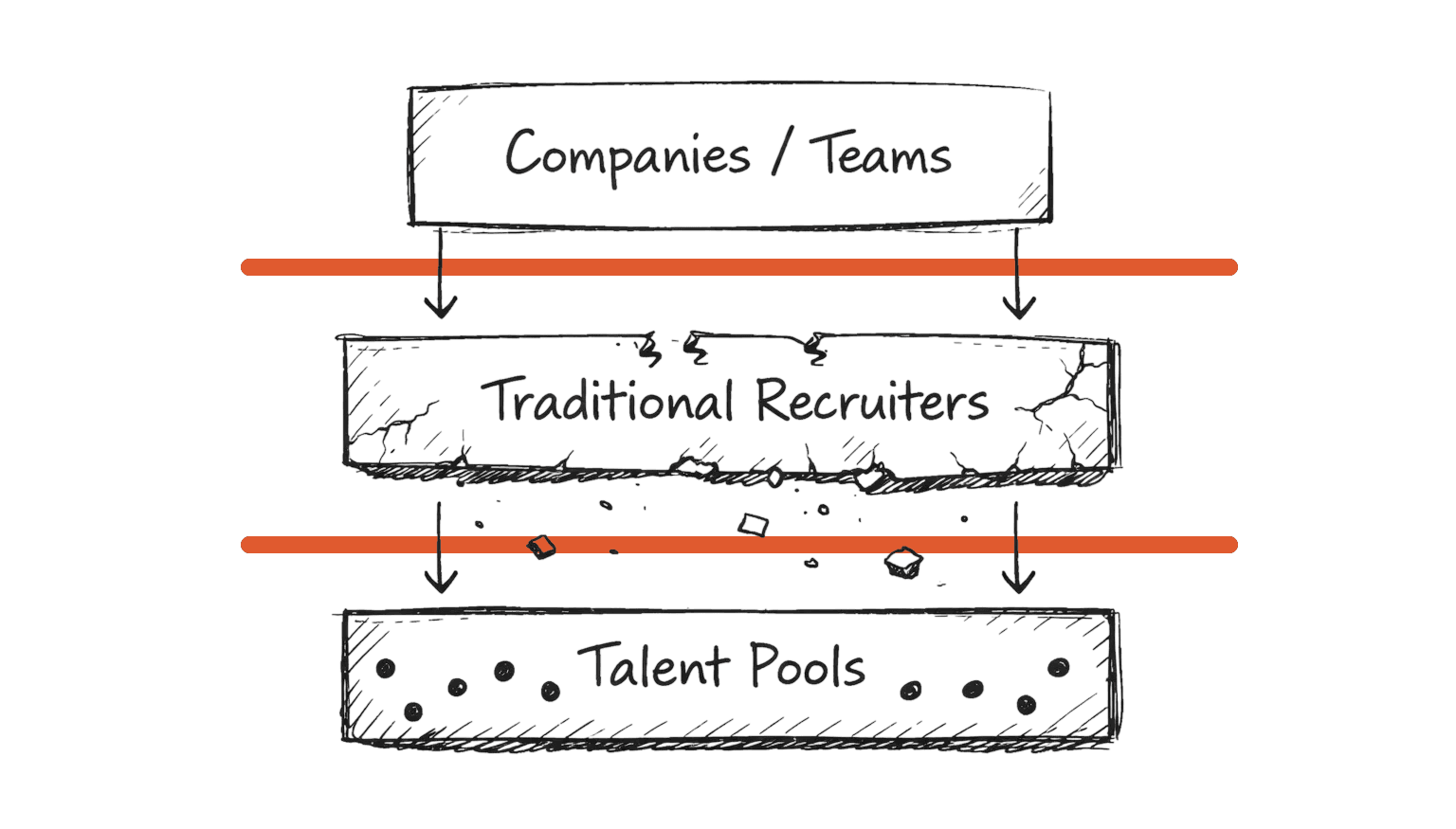
The recruiters who survive AI disruption share two traits: deep technical knowledge or access to exceptional talent. Everything else is being automated.
AI is automating the transactional parts of recruitment—resume parsing, initial screening, scheduling. Companies can now do in minutes what used to take recruiters days.
But this isn't a story about technology replacing people. It's about which people become more valuable—and which become redundant.
If a recruiter's main skill is being good at LinkedIn, they're in trouble. LinkedIn now has AI doing exactly that. The survivors are those who bring something an algorithm cannot replicate.
The Two Things That Matter
Industry analysis is clear: the recruiters thriving amid AI disruption fall into two categories.
Deep Technical Knowledge
They genuinely understand the technology. They can personally vet a software engineer's coding ability, evaluate an architect's portfolio, or discern true skill from buzzwords.
Access to Exceptional Talent
They've cultivated a pool of high-quality candidates—people who aren't easily found on LinkedIn, who trust the recruiter, and who will take their call.
These two advantages are related. Technical expertise builds trust with talented candidates. A well-curated network attracts more quality referrals. Each reinforces the other.
Why Technical Knowledge Matters
An algorithm can match keywords. It can filter for years of experience or specific certifications. What it cannot do is evaluate whether a candidate actually knows what they're talking about.
What Technical Recruiters Can Do
- Spot the difference between someone who's used a technology and someone who understands it
- Ask follow-up questions that reveal depth vs. surface knowledge
- Evaluate portfolio work and code quality, not just résumé bullet points
- Match candidates to roles based on genuine technical fit, not keyword overlap
This is why specialist tech recruiters who genuinely understand the technology still provide value. As IMD notes, data-driven tools can evaluate technical skills with precision on paper, but "fall short in assessing softer qualities like creativity, cultural match, and the potential for growth."
A recruiter who has actually shipped software, worked in data science, or led engineering teams brings judgment that no screening algorithm can replicate.
Why Talent Networks Matter
The best candidates aren't on the market. They're not applying to job postings or responding to LinkedIn InMails from strangers. They're busy doing good work—and they'll only move for the right opportunity, presented by someone they trust.
of hires come from passive candidates
response rate when contacted by a known recruiter
of agency placements predicted to disappear as companies direct-source
Recruiters with cultivated talent pools have something that can't be bought: relationships. These candidates will take their call. They trust the recruiter's judgment about which opportunities are worth considering.
Executive Search
Confidential C-suite networks built over years of relationship-building.
These placements require discretion and strategic judgment—not keyword matching.
Niche Specialists
Cybersecurity headhunters, data science recruiters, AI/ML specialists.
Well-curated pools of top talent that aren't easily found—or won't respond—on LinkedIn.
What's Being Automated
The flip side is stark. 70% of companies will use AI for hiring in 2025. The transactional work—resume screening, initial outreach, scheduling—is being automated at scale.
✗ Disappearing
- • CV-forwarding without evaluation
- • LinkedIn database searching
- • Generic candidate outreach
- • High-volume, low-touch placements
✓ Growing in Value
- • Technical vetting and evaluation
- • Relationship-based sourcing
- • Strategic talent advisory
- • Access to passive candidates
SHRM research shows AI can reduce hiring costs by 30% and screening time by 75%. This is exactly why the "middle layer" recruiter—whose main value was processing applications—is being squeezed out.
What This Means
For companies: the recruiters worth paying for are those who bring expertise or access you don't have internally. If all they're doing is searching LinkedIn and forwarding CVs, you can do that yourself—or let AI do it.
For recruiters: the path forward is clear. Develop genuine technical depth in your domain. Build relationships with exceptional candidates who trust your judgment. Become an advisor, not a database operator.
As the World Economic Forum puts it: "The story of AI in recruitment is not one of replacing human judgment but of amplifying human potential."
The question is whether you have judgment worth amplifying. If your value is expertise and relationships, AI makes you more valuable. If your value is transactional throughput, AI makes you obsolete.
Sources
- Signal Not Noise: Your Recruiter Probably Deserves to Be Replaced by AI (Medium)
- Fast Company: 70% of Companies Will Use AI for Hiring in 2025
- SHRM: The Evolving Role of AI in Recruitment and Retention
- World Economic Forum: AI-Powered Recruitment, Inclusion & Transparency
- IMD: Recruitment in 2025—AI is a Great Aid, But Don't Forget the Personal Touch