
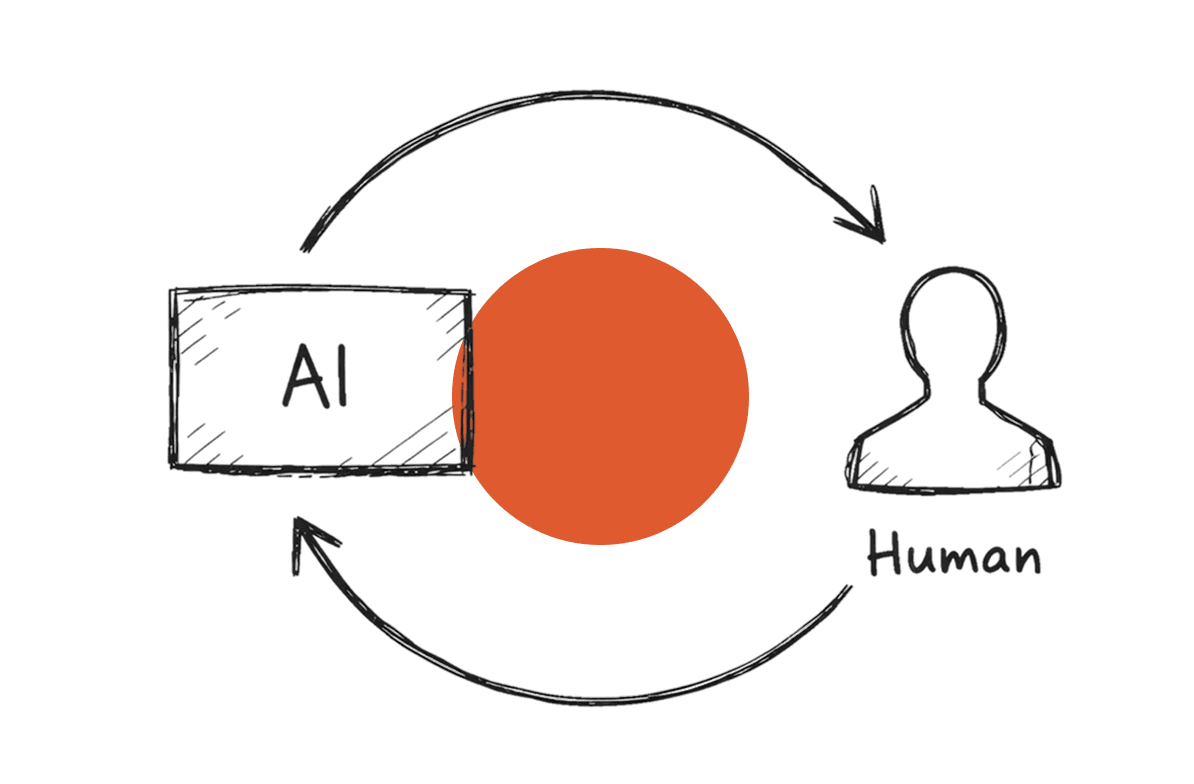
A review of real-world use cases where businesses across finance, healthcare, legal, and property have learned where AI works—and where human judgment remains essential.
The early AI playbook was simple: find every possible use case for automation. Companies asked "Where can we deploy AI?" and raced to boost efficiency.
That approach has hit walls. Across regulated industries, businesses have discovered through trial and error—sometimes costly error—exactly where AI works and where it requires human intervention.
Below are real cases from banking, healthcare, legal, and real estate. Organizations that have drawn clear lines: areas where they've chosen not to use AI, and areas where they've built mandatory human checkpoints into AI-assisted workflows.
In high-stakes environments, a single unchecked AI decision can cause serious damage before anyone notices. The strategic question has shifted from "Where can we use AI?" to "Where must we keep humans involved?"
Defining Trust Boundaries
Trust boundaries mean deciding which decisions can be fully automated—and which must include human judgment. This comes down to risk and complexity.
✓ Safe to Automate
- • Low-value, routine transactions
- • Simple customer queries
- • Data processing and formatting
- • Initial screening and triage
✗ Requires Human Review
- • High-impact financial decisions
- • Medical diagnoses and treatment
- • Legal determinations
- • Ambiguous edge cases
A recent European Central Bank survey found that banks embracing AI for credit scoring and fraud detection still impose limits:"the higher the risk, the more human validation is involved." No major bank allows critical credit decisions without human oversight.
AI does not absolve humans of responsibility—it enhances it. The trust-but-verify approach has become a mantra in regulated sectors.
Building in Human Review
Designing AI systems with human-in-the-loop guardrails is now best practice—especially in regulated industries. Rather than tacking on oversight at the end, successful teams integrate human review at key checkpoints from the start.
Design checkpoints upfront
When mapping an AI-driven workflow, explicitly decide where a person must intervene or give approval. A loan processing AI might pause for officer approval if the loan exceeds policy thresholds or model confidence is low.
Define clear escalation policies
A clear rubric eliminates ambiguity: 'Escalate any mortgage application that flags potential fraud or falls into a gray area for underwriting.'
Empower reviewers
Oversight shouldn't be an afterthought for junior staff—it needs to be an intentional, empowered role with the right tools and authority.
Target appropriate escalation rates
Aim for 10–15% escalation, keeping reviewers sharp without being overwhelmed. Explainability dashboards and clear audit trails help reviewers act quickly.
As BCG notes: "Meaningful oversight requires more than putting humans in the loop—it must be built as an integral part of the system."
When the Model Is Unsure
One of the most important guardrails: deciding what to do when the AI itself isn't confident.
AI models often output confidence scores with their predictions. Leading teams leverage this by setting confidence thresholds that determine whether the AI should proceed or escalate.
Typical confidence threshold for most business domains
Required for healthcare AI before acting autonomously
Customer support chatbot threshold (lower stakes)
Think of it as the AI's ability to "know when it doesn't know." According to Galileo's research, if confidence is ≥90%, proceed; if below 90%, flag a human reviewer.
Amazon's product matching AI handles millions of listings using confidence-based workflow: automatic matches when certain, human review for low-certainty cases. This prevents errors and provides valuable data for model improvement.
A well-designed AI will "check itself before wrecking itself"—using confidence checks as a safety net that kicks tasks to a human whenever uncertainty exceeds the trust boundary.
Real-World Sector Examples
Finance & Banking
- AI for credit scoring and fraud detection with human validation for high-risk decisions
- Consumer protection rules require human review and appeal for AI-driven credit decisions
- Anti-money laundering systems flag transactions for human investigation
Healthcare
- AI can sift patient data or flag anomalies, but doctors make diagnoses
- Clinicians interpret AI findings with medical expertise and ethical judgment
- FDA requires human oversight for AI-powered medical devices
Legal
- AI can draft documents and research case law, but lawyers review court submissions
- Fabricated citations have led to sanctions when attorneys didn't verify
- Lawyer ethics require gatekeeping responsibility for AI outputs
Real Estate
- AI valuation models require licensed human appraiser sign-off
- Regulations mandate auditing automated valuation systems for bias
- AI struggles with unique properties—humans spot intangibles algorithms miss
As real estate experts note: real estate deals carry legal weight and financial risk. If an AI mis-prices a unique property, only a human would notice the nuance—like a historic feature or renovation the data didn't capture.
Making It Work: The Guardrail Framework
Across these examples, a pattern emerges that crystallizes modern AI strategy. Organizations that get this right implement key practices:
1Risk-Tiered Automation
Classify AI use cases by risk level (the EU AI Act uses categories: unacceptable risk = forbidden, high-risk = require human oversight). Low-risk tasks can be fully automated; high-risk ones must involve human review by design.
2Confidence-Based Escalation
Set concrete confidence score thresholds: "If confidence <X% or decision falls in top Y% of potential loss/exposure, escalate to human." Use 80–90% as a baseline, tuning per domain (closer to 95% for life-and-death decisions).
3Human Override & Authority
Empower front-line staff to override AI decisions quickly. The EU AI Act will require human operators to "have the authority to intervene or disable" AI systems in high-risk scenarios.
4Transparent Explanation
Invest in explainable AI tools and audit trails so reviewers understand AI outputs. An AI lending platform might show underwriters which factors led to a loan denial, allowing them to spot if the AI missed something contextual.
5Continuous Feedback Loops
Treat human-in-the-loop as a learning mechanism. Every human correction can refine the model. Monitor escalation frequency and override rates—if too many cases are kicked up or overridden, it flags a problem.
Improvement in decision accuracy with human-in-the-loop frameworks
Reduction in harmful outcomes when AI isn't left alone in uncertain cases
According to AI Journal research, implementing these frameworks measurably improves outcomes—precisely because AI isn't left on its own in uncertain cases.
Strategy = Defining Where Humans Stay Central
For ops leaders in finance, legal, healthcare, real estate, and other high-stakes fields, the takeaway is clear: an AI strategy is as much about people as technology.
It's no longer just "Where can we add AI for efficiency?" It's also "Where must we retain human judgment, and how do we seamlessly integrate it?"
By defining trust boundaries—the lines of decision-making that AI is not allowed to cross without human say-so—organizations create a safety net for reliability and ethics.
Yes, involving humans can introduce friction and cost. But forward-thinking teams treat that not as a burden, but as an investment in trust and quality.
When done right, human oversight enhances AI's performance—catching errors, providing context, and continuously improving the AI through feedback. Companies with strong human-in-the-loop practices achieve more accurate and fair outcomes, and avoid the reputational disasters that come from unchecked AI mistakes.
The winning AI strategy is a balanced partnership: let AI do what it does best (speed, scale, pattern-crunching) and let humans do what they do best (judgment, empathy, accountability).
Define clearly where the two intersect—those trust boundaries where a person must stay in the loop. The organizations that thrive with AI will be those that keep people in charge of the mission, even as machines work alongside.
Sources
- AI Journal: Confidence Thresholds and Human Overrides
- AppMaisters: Understanding the Human Role in AI Development
- Working RE: Five Reasons AI Cannot Replace Real Estate Appraisers
- ECB: AI's Impact on Banking
- Galileo: How to Build Human-in-the-Loop Oversight for AI Agents
- BCG: You Won't Get GenAI Right if Human Oversight is Wrong
- nCino: The Revolution of AI Credit Decisioning in Banking